FDM vs SLA comes down to this: FDM builds tough, low-cost parts from plastic filament, and SLA builds smooth, finely detailed parts from liquid resin. Choose FDM when the part has to work, and SLA when it has to look right or hold very fine detail.
That rule covers most cases, but not all. Engineering resins have closed part of the strength gap, and FDM cannot match SLA on small features at any price. The sections below show where each process wins.
How FDM and SLA Work
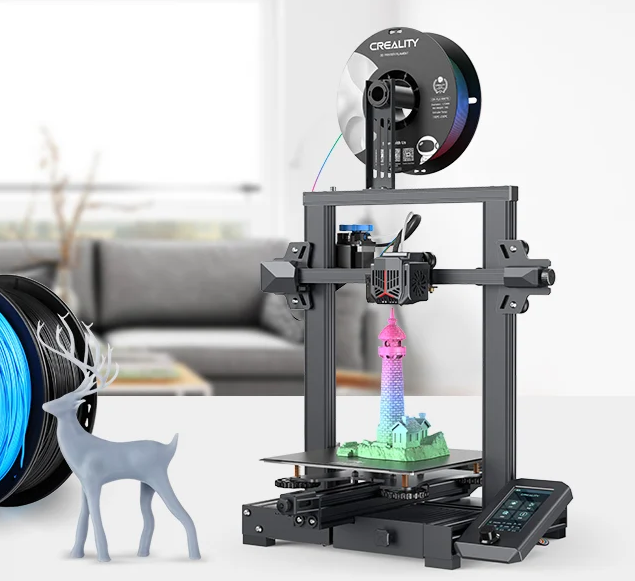
FDM (fused deposition modeling) melts a plastic filament and lays it down through a nozzle, one line at a time and one layer on top of another. It is also called FFF. The part is solid thermoplastic, the same family of materials used in injection molding.
SLA (stereolithography) cures liquid photopolymer resin with light, one thin layer at a time. Printers sold as MSLA or LCD resin printers use an LCD screen in place of a laser, but the result is similar. The part comes out of a resin tank, then has to be washed and cured.
FDM vs SLA at a Glance
| FDM | SLA | |
|---|---|---|
| Raw material | Thermoplastic filament | Liquid photopolymer resin |
| Typical layer height | About 0.1–0.4 mm | About 0.025–0.05 mm |
| Typical tolerance | ±0.2 mm or ±0.5% | ±0.15 mm or ±0.3% |
| Surface finish | Visible layer lines | Smooth, close to molded |
| Fine detail | Limited by nozzle width | Very fine |
| Strength | Tough, but weaker between layers | Uniform in all directions; standard resins are brittle |
| Material cost | Lower | Higher |
| Post-processing | Remove supports | Remove supports, wash, UV cure |
| Best for | Functional parts, jigs, enclosures, large parts | Detailed prototypes, visual models, casting patterns, small precise parts |
Tolerance and layer figures are typical values for commercial print services; a well-tuned machine can do better and a poorly tuned one worse.
Detail and Surface Finish
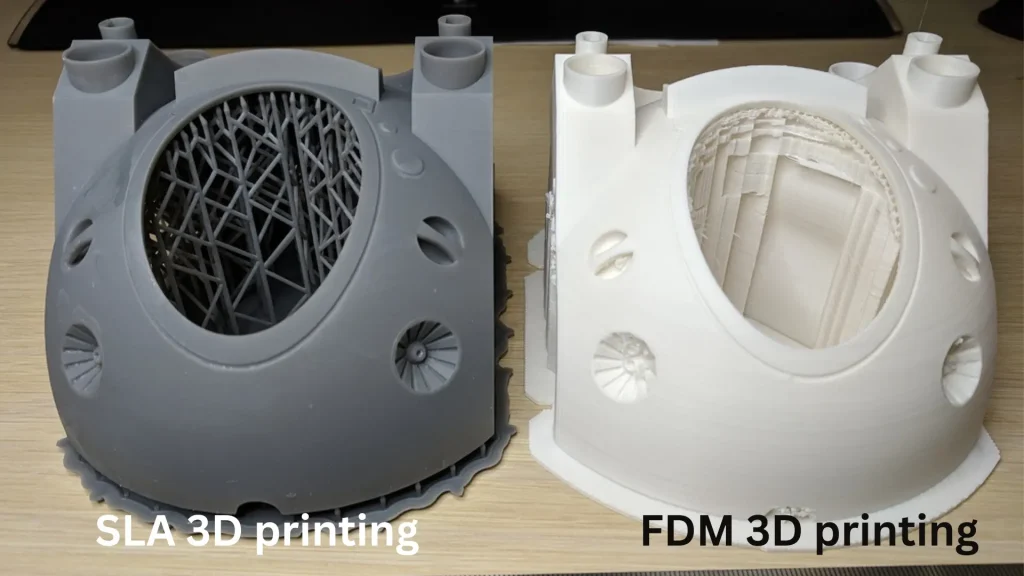
SLA wins clearly. Its layers are several times thinner, and the smallest feature is set by a spot of light, not by the width of a nozzle. Text, threads, thin walls, and sharp edges come out crisp, and surfaces are smooth enough to paint or use as a casting pattern with little preparation.
FDM parts show layer lines, most visibly on curved and sloped surfaces. A smaller layer height and sanding or filler primer improve them, at the cost of time. For a bracket hidden inside a machine this does not matter; for a customer-facing model it does.
Strength and Durability
FDM wins for most working parts. Filaments such as PETG, ABS, and nylon are tough: they bend and absorb impact before they break. Standard SLA resins are stiff and brittle by comparison, and many become more brittle with long exposure to sunlight.
Two qualifications matter:
- FDM parts are weaker between layers. The bond between layers is not as strong as the extruded plastic itself, so a part loaded across its layers can split. Print orientation has to be planned around the load.
- SLA parts are uniform. The cured resin forms a continuous network, so strength is nearly the same in every direction, and the part is watertight. Engineering resins sold as “tough”, “durable”, or “high-temp” get much closer to thermoplastic performance, at a higher price.
For heat, compare the specific materials, not the processes. Ordinary PLA softens at about 60 °C, lower than many resins, while ABS and polycarbonate handle more than standard resins do.
Materials
FDM uses real engineering thermoplastics: PLA, PETG, ABS, ASA, nylon, polycarbonate, flexible TPU, and carbon-fiber-filled grades. If a part must match the behavior of a molded plastic part, FDM lets you print in the same or a closely related material. See PLA vs ABS vs PETG and our 3D printing material selection guide.
SLA resins are formulated for a purpose: standard, tough, flexible, high-temperature, clear, castable (for jewelry and investment casting), and biocompatible dental and medical grades. Clear and castable parts are things FDM cannot really do.
Cost and Speed
FDM is cheaper to run. Common filament starts around $30 per kilogram, while standard resins typically cost $100 to $200 per liter. Entry-level printers of both types start at a few hundred dollars, so the machine is rarely the deciding factor; material and labor are.
Print speed depends on the part. Resin printers that use an LCD screen cure a whole layer at once, so several small parts take about as long as one. FDM is usually faster and far cheaper for a single large part. SLA also needs washing and curing after printing, which adds handling time.
Post-Processing and Safety
An FDM part is ready once the supports are removed. An SLA part needs three steps: wash off the uncured resin in a solvent, usually isopropyl alcohol; cure it under UV light; then remove supports and sand the marks they leave.
Uncured resin is a skin irritant and must be handled with gloves, with ventilation, and disposed of properly. Filament is clean and safe to handle, though ABS and ASA give off fumes during printing and need ventilation too.
FDM vs SLA for Functional Parts
For parts that carry load, take impact, or live in a workshop, FDM is the default. It is tougher, cheaper, available in real engineering plastics, and scales to large sizes. This is what we use for most functional part printing.
SLA is the better choice for a functional part in four situations:
- Small, precise features: fine threads, snap details, small gears, connector housings.
- Watertight or airtight parts: fluid channels, manifolds, sealed housings.
- Smooth sliding or sealing surfaces where layer lines would cause friction or leaks.
- Uniform strength in every direction, when you cannot orient an FDM part to suit the load.
In those cases, specify a tough or durable engineering resin, not a standard one.
Which Should You Choose?
| If your part is… | Choose |
|---|---|
| A bracket, mount, jig, or fixture | FDM |
| An enclosure or housing | FDM |
| Larger than about 20 cm in any direction | FDM |
| Used outdoors or near heat | FDM (ASA, ABS, or polycarbonate) |
| An early fit-check prototype | FDM |
| A presentation or appearance model | SLA |
| Small with fine detail, text, or thin walls | SLA |
| A pattern for casting or molding | SLA |
| Clear or translucent | SLA |
| Watertight with internal channels | SLA |
Many projects use both: FDM for quick, cheap design iterations, then SLA for the final appearance model, as described in our guide to rapid prototyping. Whichever you choose, a design-for-3D-printing review catches wall thickness and support problems before printing.
Frequently Asked Questions
Is SLA stronger than FDM?
Usually not. Standard resins are more brittle than common FDM plastics such as PETG and ABS. SLA parts are, however, equally strong in every direction, while FDM parts are weaker between layers. Tough engineering resins narrow the gap.
Is SLA more accurate than FDM?
Yes, in general. SLA has thinner layers and finer feature resolution, and typical service tolerances are tighter: about ±0.15 mm or ±0.3% for SLA against ±0.2 mm or ±0.5% for FDM.
Which is cheaper, FDM or SLA?
FDM. Filament costs less than resin, there is no washing or curing step, and no solvent to buy and dispose of.
Can SLA resin prints be used for functional parts?
Yes, with the right resin. Tough, durable, and high-temperature engineering resins are made for working parts. Standard resin is best kept for models and prototypes.
Which is better for beginners?
FDM. It is cleaner, safer, cheaper to run, and more forgiving. Resin printing involves handling chemicals and extra finishing steps.
What is the difference between SLA, DLP, and MSLA?
All three cure liquid resin with light. SLA uses a laser, DLP a digital projector, and MSLA an LCD screen as a mask. Print quality is broadly similar, and most low-cost resin printers today are MSLA.
Not Sure Which Process Fits Your Part?
RunTechEngineer chooses the process and material from what your part has to do, not from what happens to be loaded in the machine. See our 3D printing services, or contact us with your model and how the part will be used.