The Short Answer
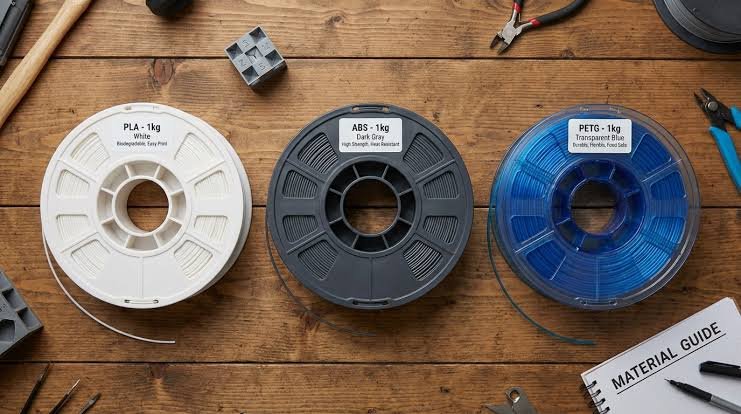
PLA, ABS, and PETG are the three most common filaments for FDM 3D printing, and each one wins in a different area:
- PLA is the easiest to print and gives the cleanest detail, but it softens at low temperatures and is brittle.
- ABS handles the most heat and takes impacts well, but it warps easily and needs an enclosed printer.
- PETG sits in the middle: tougher and more heat resistant than PLA, and far easier to print than ABS.
If you only remember one rule, use PLA for models and prototypes, PETG for functional parts, and ABS when the part has to survive heat.
What Are PLA, ABS, and PETG?
PLA (polylactic acid) is a plastic made from plant starch such as corn or sugarcane. It melts at a low temperature, barely shrinks as it cools, and prints well on almost any machine. This is why most printers ship with a sample spool of PLA.
ABS (acrylonitrile butadiene styrene) is the petroleum-based plastic used in LEGO bricks, power tool housings, and car interior trim. It was the standard filament in the early days of desktop 3D printing and is still a common choice for engineering parts.
PETG (polyethylene terephthalate glycol) is a modified version of the PET used in water bottles. The added glycol makes it clearer, less brittle, and easier to print. It has become the default material for functional parts on open-frame printers.
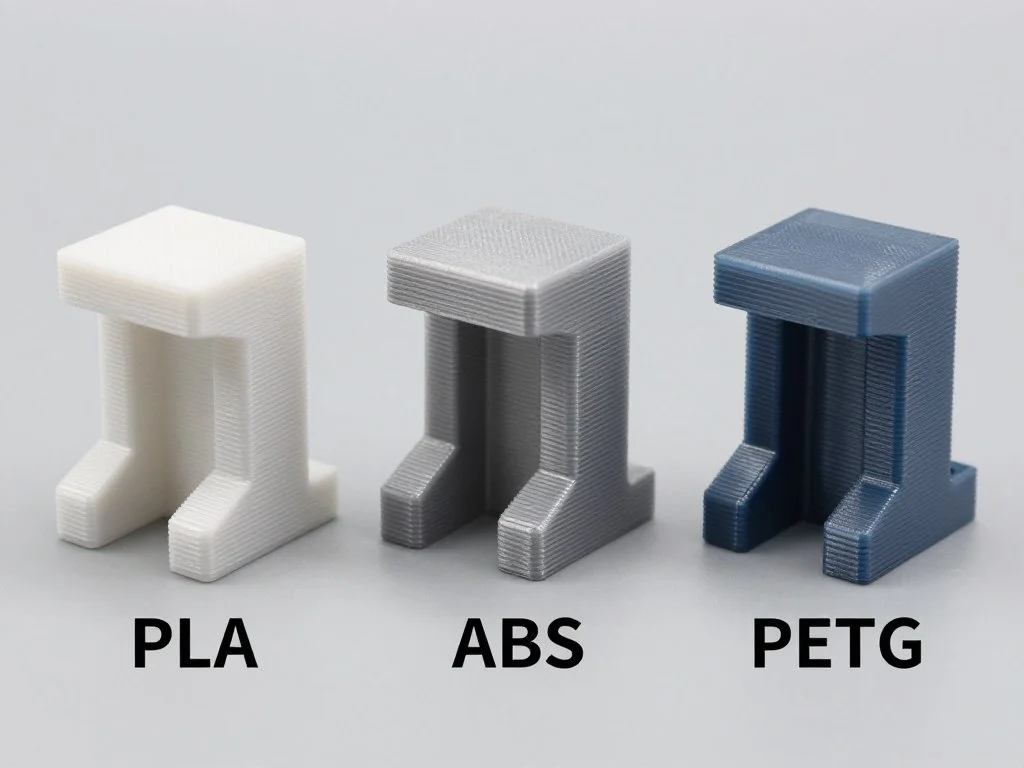
PLA vs ABS vs PETG Comparison Table
| Property | PLA | ABS | PETG |
|---|---|---|---|
| Ease of printing | Very easy | Difficult | Moderate |
| Nozzle temperature | 190 to 220 °C | 230 to 260 °C | 230 to 250 °C |
| Bed temperature | 50 to 60 °C | 90 to 110 °C | 70 to 85 °C |
| Enclosure needed | No | Yes | No |
| Softens at (glass transition) | About 60 °C | About 100 °C | About 80 °C |
| Stiffness | High | Medium | Medium to low |
| Impact resistance | Low | Good | Good |
| Warping | Minimal | High | Low |
| Outdoor use | Poor | Fair, better if painted | Good |
| Fumes while printing | Low | Strong, needs ventilation | Low |
These are typical ranges. Exact values change between brands and blends, so always check the label on your spool.
Strength: Which Filament Is Strongest?
The answer depends on what you mean by strong.
PLA is the stiffest. On a tensile test it often scores higher than both ABS and PETG, which surprises many beginners. The problem is how it fails. PLA barely bends before it snaps, so a PLA bracket that is overloaded or dropped tends to crack suddenly.
PETG is the toughest for everyday use. It bends and stretches before it breaks, and its layers bond to each other very well. This makes PETG parts less likely to split along the layer lines, which is the usual weak point of any FDM print.
ABS handles impact and fatigue well. It flexes under shock instead of shattering, which is why it is used for housings and enclosures. Its layer adhesion is weaker than PETG unless it is printed in a warm, enclosed chamber.
For a part that carries load or gets knocked around, PETG or ABS is usually the safer choice than PLA, even though PLA looks stronger on paper.
Heat Resistance
Heat resistance is where the three materials differ the most. The key number is the glass transition temperature, the point where the plastic starts to soften and lose its shape.
- PLA softens at about 60 °C. A PLA part left inside a parked car in the sun, or mounted near a motor, can deform.
- PETG softens at about 80 °C. This is enough for most indoor and outdoor uses, but not for parts near hot machinery.
- ABS holds its shape up to about 100 °C. It is the right choice for parts close to engines, electronics that run hot, or heated equipment.
In a hot climate this matters more than people expect. If a part will sit in direct sun or inside a vehicle, PLA is rarely the right material.
Printability and Settings
PLA is forgiving. It sticks to the bed easily, likes a lot of cooling fan, and rarely warps. It is the best material for learning how a printer behaves and for parts with fine detail or sharp overhangs.
PETG needs a little more tuning. It prints hotter and tends to leave thin strings between features, so retraction settings and a slightly lower fan speed matter. It can also bond too strongly to smooth PEI or glass beds, so a textured sheet or a thin layer of glue stick as a release agent is a good idea.
ABS is the hardest of the three. It shrinks as it cools, which pulls corners off the bed and can crack tall parts between layers. To print it reliably you need a heated bed at around 100 °C, an enclosure that keeps the air warm, and almost no cooling fan. ABS also gives off a strong smell and styrene fumes, so the printer should be in a ventilated room or have a filter.
Outdoor Use and Moisture
PLA is the weakest choice outdoors. Sunlight and heat make it brittle and can warp it over time.
ABS tolerates heat well but slowly yellows and becomes brittle under UV light. Painting or coating the part extends its life. For parts that stay outside permanently, ASA, a close relative of ABS with much better UV resistance, is often used instead.
PETG is the best of the three for outdoor parts. It resists UV and water better than PLA and is not affected by rain or humidity once printed.
One point that is often misunderstood: finished PETG parts handle water well, but PETG filament on the spool absorbs moisture from the air. Wet filament causes stringing, bubbles, and weak layers. All three materials print better when they are stored dry, and PETG and ABS benefit most from drying before use.
Are They Food Safe?
The base plastics can be food safe, but a printed part usually is not. There are three reasons:
- Pigments and additives in the filament are rarely tested for food contact.
- The tiny gaps between layers trap food and moisture, which lets bacteria grow.
- Brass nozzles can contain small amounts of lead.
For anything that touches food repeatedly, use a filament that is certified for food contact, a stainless steel nozzle, and a food-grade coating to seal the surface. Otherwise, treat printed parts as not food safe.
Post-Processing
- PLA sands and paints well with a primer, but it clogs sandpaper if it gets warm.
- ABS is the easiest to finish. It sands cleanly, glues well, and can be smoothed with acetone vapour to a glossy surface with no visible layer lines.
- PETG is harder to sand and does not react to acetone. Wet sanding followed by paint gives the best result.
Cost
All three are low-cost materials, and standard spools are priced close to each other. PLA is usually the cheapest and has the widest choice of colours. The real cost difference comes from failed prints: ABS wastes more material and time if the printer is not set up for it.
Which Filament Should You Choose?
| Your part | Best choice | Why |
|---|---|---|
| Display models, figurines, visual prototypes | PLA | Best detail and surface, easiest to print |
| Fit-check prototypes | PLA | Fast, cheap, dimensionally stable |
| Brackets, mounts, jigs, and fixtures | PETG | Tough, good layer bonding, moderate heat resistance |
| Outdoor parts | PETG | Better UV and water resistance |
| Enclosures for electronics | PETG or ABS | ABS if the electronics run hot |
| Parts near motors or inside vehicles | ABS | Highest heat resistance of the three |
| Parts that need a smooth, glossy finish | ABS | Can be vapour smoothed with acetone |
If none of the three is enough, the next step is usually an engineering material such as ASA, nylon, or a carbon fibre blend.
Common Mistakes When Choosing a Filament
- Choosing PLA for a functional part because its tensile strength looks high on a data sheet.
- Printing ABS on an open-frame printer and blaming the machine for the warping.
- Using PLA for parts that will sit in a car or in direct sun.
- Assuming PETG never needs drying because the finished plastic is water resistant.
- Treating any printed cup or utensil as food safe.
Frequently Asked Questions
Is PETG stronger than PLA? PLA is stiffer and scores higher in a tensile test, but PETG is tougher. It bends instead of snapping and its layers bond better, so it survives impacts and repeated loads that would crack PLA. For the numbers, see how strong PLA is.
Is PETG better than ABS? For most users, yes. PETG is easier to print, does not need an enclosure, and produces fewer fumes. ABS is still the better choice above about 80 °C or when you need acetone smoothing.
Which filament is best for beginners? PLA. It prints at low temperatures, rarely warps, and works on every FDM printer without an enclosure.
Can you print ABS without an enclosure? Small parts sometimes work, but larger parts usually warp or crack. An enclosure, even a simple one, makes ABS far more reliable.
Which filament is best for outdoor use? Of these three, PETG. For long-term exposure to strong sunlight, ASA is the better option.
Not Sure Which Material Your Part Needs?
RunTechEngineer matches the material to what the part actually has to do: the load it carries, the temperature it sees, and the environment it works in. Read our material selection guidance or see how we approach functional part printing.
Explore our full 3D printing services or Contact Us to discuss your part.