ASA vs ABS comes down to one question: will the part live outdoors? ASA prints almost exactly like ABS and has similar strength and heat resistance, but it stands up to sunlight and weather far better. ABS is usually tougher, slightly easier to find, and a little cheaper. This guide compares the two with real datasheet numbers and shows which to pick for your part.
The Short Answer
- Choose ASA for anything that will sit in the sun or rain: garden fittings, car exterior parts, outdoor enclosures, signs, drone parts that fly in daylight.
- Choose ABS for indoor parts that need toughness and impact resistance, parts you want to smooth with acetone vapour, and jobs where cost matters more than looks after a year outside.
- Both need a heated bed, an enclosure, and good ventilation. If your printer handles one, it handles the other.
What Is ASA?
ASA stands for acrylonitrile styrene acrylate. It was developed as a weather-resistant alternative to ABS (acrylonitrile butadiene styrene), and the two are close chemical relatives.
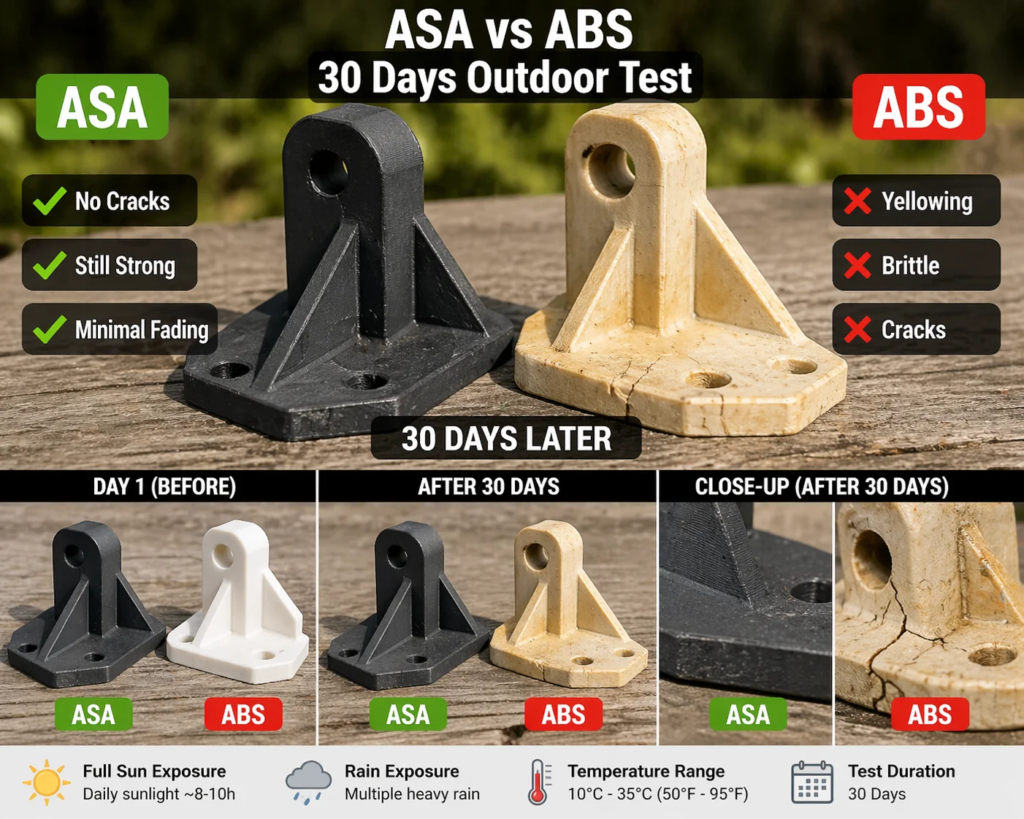
The difference is the rubber that gives each plastic its toughness. ABS uses butadiene rubber, whose molecules contain double bonds. Ultraviolet light and oxygen attack those double bonds, so ABS left in the sun yellows, loses its surface gloss, and becomes brittle over time. ASA replaces the butadiene with an acrylate rubber that has no such double bonds, so it keeps its colour and toughness outdoors much longer.
That is why ASA has long been used for injection-moulded outdoor parts such as car mirror housings, grilles, and building siding, and why it became the standard outdoor filament for 3D printing.
ASA vs ABS Comparison Table
| Property | ABS | ASA |
|---|---|---|
| UV and weather resistance | Poor; yellows and turns brittle in sunlight | Excellent; keeps colour and strength outdoors |
| Tensile strength, along layers | 33.4 MPa | 43.8 MPa |
| Tensile strength, across layers | 29.7 MPa | 32.0 MPa |
| Elongation at break | 17.9% | 6.7% |
| Notched impact strength (Charpy) | 18.0 kJ/m² | 10.3 kJ/m² |
| Heat deflection temperature (1.8 MPa) | 98 °C | 100 °C |
| Glass transition | 101 °C | 98 °C |
| Nozzle temperature | 245–265 °C | 230–260 °C |
| Bed temperature | 90–100 °C | 75–95 °C |
| Enclosure | Needed | Needed |
| Part cooling fan | Off | Off |
| Acetone smoothing | Yes | Yes |
Strength and Toughness
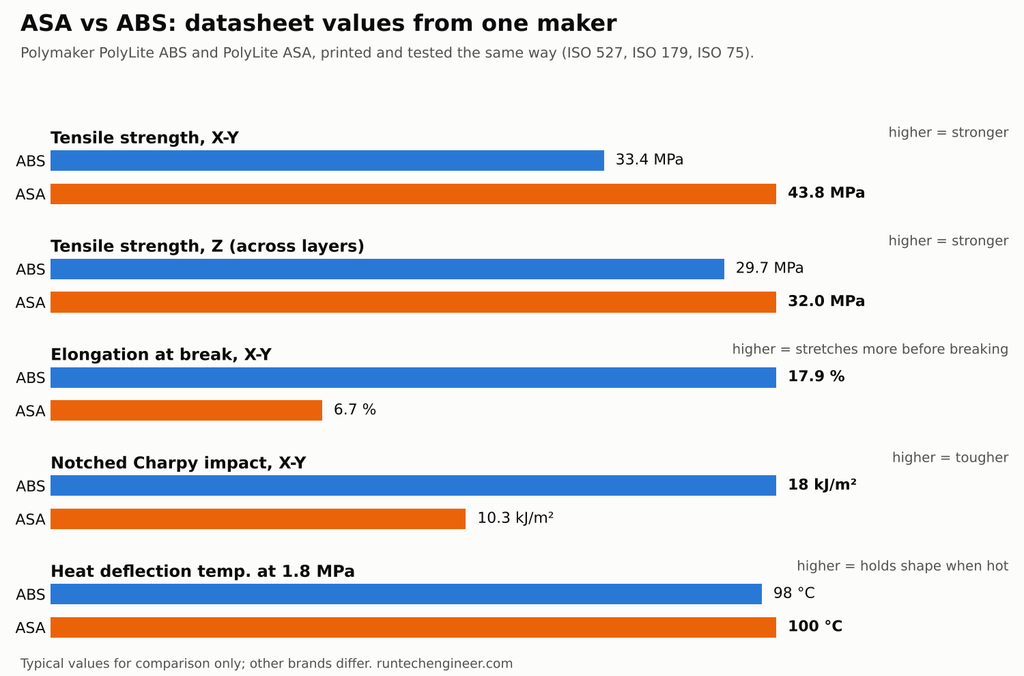
The numbers come from one manufacturer, Polymaker, which prints and tests its PolyLite ABS and PolyLite ASA in the same way. That makes the comparison fair, but every brand is different, so treat the values as a guide rather than a specification.
ASA is usually slightly stronger, and ABS is usually tougher.
In the Polymaker data, ASA reaches 43.8 MPa in tension along the layers against 33.4 MPa for ABS. Across the layers, the weak direction of every FDM part, the gap narrows to 32.0 against 29.7 MPa. Stratasys reports the same pattern for its industrial filaments: 32.8 MPa for ASA against 30.8 MPa for ABS-M30.
ABS, on the other hand, stretches much further before it breaks (17.9% against 6.7% in the Polymaker tests) and absorbs almost twice the energy in a notched impact test. A part that gets knocked, dropped, or snapped into place will usually survive better in ABS. A part that carries a steady load will do slightly better in ASA.
For a part that carries real load, use the across-layer value and leave a margin. Our guide to the factor of safety explains why plastic parts need a larger one than metal.
Heat Resistance
There is little to choose between them. Both soften at around 100 °C, and their heat deflection temperatures under load are within a few degrees. Either one is a clear step up from PLA, which softens at about 55 to 60 °C, and from PETG. See PLA vs ABS vs PETG for that comparison.
UV and Weather Resistance
This is the reason ASA exists. Indoors, ABS and ASA behave much the same. Outdoors, they part ways.
- ABS in sunlight gradually yellows, its surface turns chalky, and it becomes brittle. A bracket that flexed happily when new can crack after a season or two in strong sun. Dark colours and paint slow this down, but do not stop it.
- ASA in sunlight keeps its colour and toughness far longer. It is the material of choice for injection-moulded car exterior trim and building siding for exactly this reason.
- Rain and humidity affect neither one much once printed. Both absorb a little moisture as filament, so dry the spool before printing (Polymaker suggests 70 °C for 6 to 7 hours).
If you live somewhere with strong year-round sun, as across most of Southeast Asia, the difference shows up quickly. For any part that will be outside for more than a few weeks, ASA is the safer choice. The material selection guide covers the other outdoor options, such as PETG and polycarbonate.
Printing ASA and ABS
The two print so similarly that most printer profiles treat them as siblings. The same habits apply to both:
- Use an enclosure. Both shrink as they cool. An open printer in a draughty room lets the corners lift (warping) and the layers split (delamination), especially on parts longer than about 100 mm.
- Turn the part cooling fan off, or nearly off. Fast cooling causes the same cracking between layers.
- Heat the bed. About 90 to 100 °C for ABS, 75 to 95 °C for ASA, on a textured PEI or PC sheet. A brim helps on large flat parts.
- Ventilate. Both give off a noticeable smell and fine particles while printing. Print in a room with fresh air, or use an enclosure with a filter, and do not sit next to the printer for hours.
- Allow for shrinkage. Both shrink slightly more than PLA or PETG, which affects holes and fits. Our guide to 3D printing tolerances gives clearances to start from.
Many users find ASA a little more forgiving on warping than ABS, but this depends heavily on the brand and the printer. If you already print ABS successfully, ASA will need little or no change.
Post-Processing
Both sand, drill, tap, and glue well, and both dissolve in acetone. That means both can be vapour-smoothed with acetone for a glossy, sealed surface, and both can be welded with an ABS or ASA “slurry” (scraps dissolved in acetone). Handle acetone with care: it is highly flammable and its vapour should not be breathed.
ABS takes paint well and is often painted to protect it outdoors. ASA usually does not need paint for UV protection, but can be painted for colour.
Cost and Availability
ABS is one of the oldest and most widely sold filaments, so it is easy to find in almost any colour and is usually a little cheaper. ASA has become common from the major brands, but the price per spool is typically somewhat higher and the colour range at a given shop can be smaller. Industrial FDM systems offer both.
The real cost difference is often failure, not the spool. A cheaper ABS part that cracks outside after six months and has to be reprinted ends up costing more than an ASA part that lasts.
Which Should You Choose?
| Your part | Better choice | Why |
|---|---|---|
| Outdoor fitting, garden part, sign, mailbox part | ASA | Resists UV and weather |
| Car exterior part, mirror or trim piece | ASA | Sunlight and heat in one part |
| Drone or RC part used outdoors | ASA | Stays tough in sunlight; similar weight |
| Indoor enclosure, jig, or fixture | ABS | Tougher, cheaper, UV does not matter |
| Snap-fit or part that gets knocked | ABS | Higher elongation and impact strength |
| Part to be acetone-smoothed for looks | Either | Both smooth well |
| Car interior part near the windscreen | ASA | Sun through glass still degrades ABS |
If neither is quite right, look at PETG for easier printing with fair outdoor life, or polycarbonate and nylon for more heat or toughness. Our page on functional 3D printed parts explains how material, orientation, and wall count work together.
ASA vs ABS FAQ
Is ASA stronger than ABS?
In tension, usually yes. In Polymaker’s matched datasheets, ASA reaches 43.8 MPa against 33.4 MPa for ABS. ABS is tougher, though: it stretches further and absorbs more impact before breaking.
Is ASA better than ABS for outdoor use?
Yes. ASA was developed specifically as a weather-resistant version of ABS. ABS yellows and turns brittle in sunlight; ASA keeps its colour and toughness far longer.
Can I print ASA without an enclosure?
Small parts can work in a warm room with no draughts, but an enclosure is strongly recommended. Without one, larger ASA parts are likely to warp or crack between layers, just as ABS does.
Can ASA be smoothed with acetone?
Yes. Like ABS, ASA dissolves in acetone, so it can be vapour-smoothed and glued with an acetone slurry.
Is ASA food safe?
Do not assume so. Food safety depends on the specific filament, its colourants, the nozzle, and the layer gaps that trap bacteria. Use only a filament the maker certifies for food contact, and follow its instructions.
Need Parts That Survive Outdoors?
RunTechEngineer prints functional parts in ASA, ABS, and other engineering materials, choosing the material and print settings for where the part will actually be used. Explore our 3D printing services or contact us with your part and its environment.