A Simple Definition
A drone flight controller is the small circuit board that acts as the brain of the aircraft. It reads the drone’s sensors, listens to the pilot’s commands, and adjusts the speed of each motor many times per second to keep the drone stable and moving where it should.
A multirotor cannot fly without one. Four propellers on a frame are naturally unstable, and no human can adjust four motors fast enough by hand. The flight controller does that work continuously, so the pilot only has to say where to go.
One clarification before going further: the flight controller is the board inside the drone. The handheld unit with the sticks is the radio transmitter, also called the remote controller. The two are often confused because both are called “controller”.
What Does a Flight Controller Do?
A flight controller has four main jobs:
- Stabilise the aircraft. It detects every tilt and rotation and corrects it before the pilot would even notice.
- Translate commands into motor speeds. When the pilot pushes a stick forward, the flight controller works out how much to speed up the rear motors and slow the front ones.
- Navigate. With GPS, a compass, and a barometer, it can hold a position, hold altitude, fly a planned route, and return home on its own.
- Protect the drone. It monitors battery voltage and radio signal and triggers a failsafe action, such as landing or returning home, when something goes wrong.
How Does a Flight Controller Work?
The flight controller runs the same short cycle again and again, from hundreds to several thousand times per second depending on the firmware:
- Read the sensors. The gyroscope and accelerometer report how the drone is rotating and tilting right now.
- Read the command. The radio receiver, or the autopilot’s mission plan, says what the drone should be doing.
- Calculate the error. The controller compares the actual attitude with the desired attitude.
- Compute the correction. A control algorithm called PID decides how strongly to react.
- Command the motors. The result is sent to the electronic speed controllers (ESCs), which change the speed of each motor.
Then the cycle starts again.
PID in plain words. PID stands for proportional, integral, derivative. The proportional part reacts to how large the error is now. The integral part corrects small errors that persist, such as a steady drift in wind. The derivative part damps the reaction so the drone does not overshoot and wobble. Adjusting these three values to suit a particular frame is called tuning, which we cover in flight control system setup and tuning.
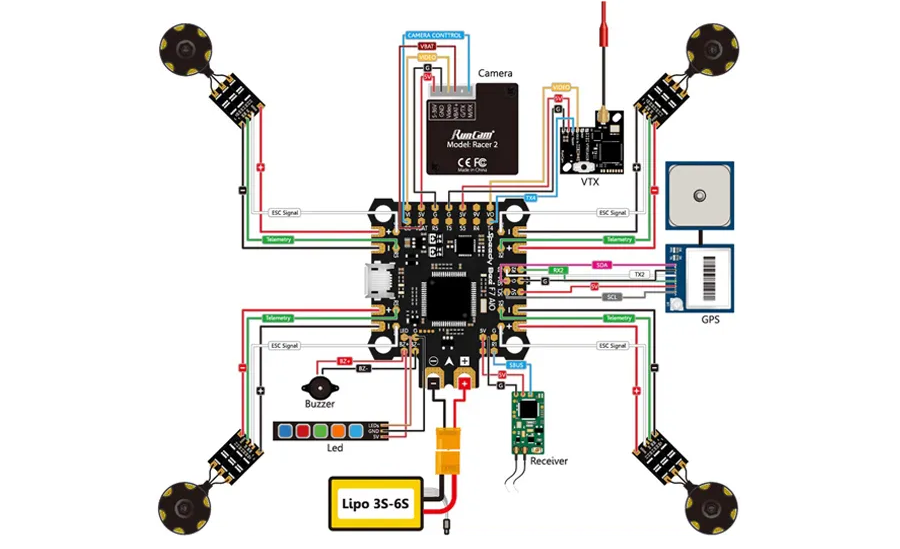
What Is on a Flight Controller Board?
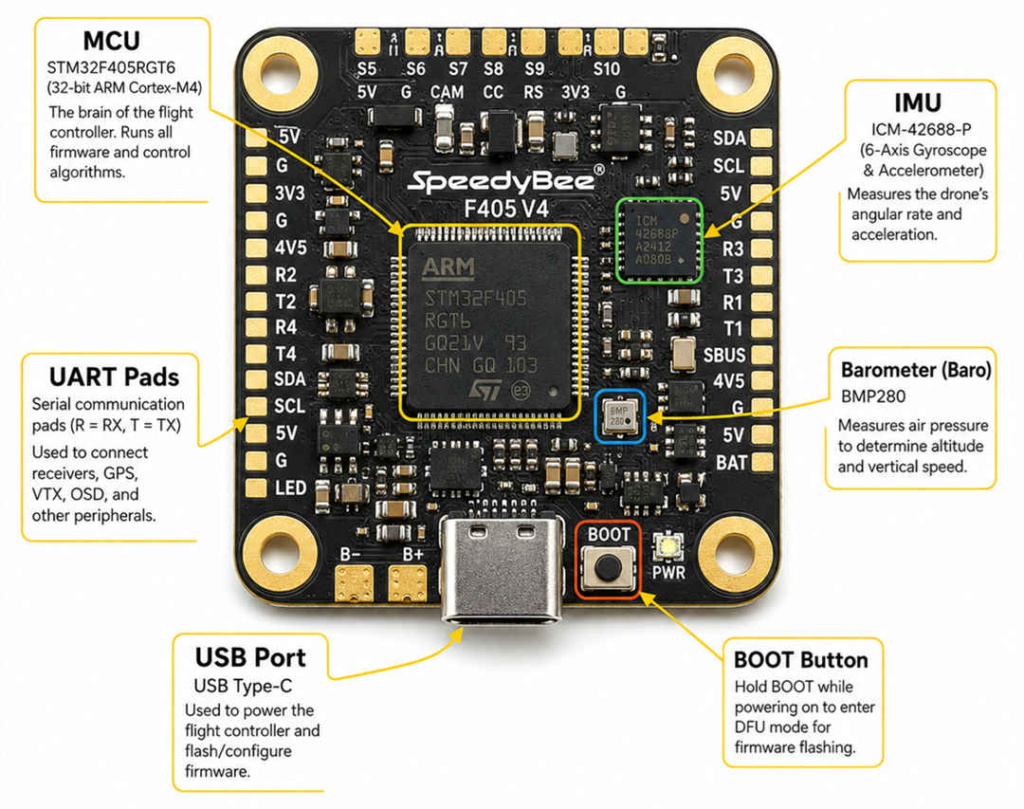
| Component | What it does |
|---|---|
| Processor | Runs the control loop. Most boards use an STM32 chip from the F4, F7, or H7 family. |
| Gyroscope and accelerometer (IMU) | Measure rotation and tilt. This is the most important sensor on the board. |
| Barometer | Measures air pressure to estimate altitude. |
| Compass (magnetometer) | Gives heading. Often placed on the external GPS module, away from electrical noise. |
| Motor outputs | Send speed commands to the ESCs. |
| Serial ports (UARTs) | Connect the receiver, GPS, telemetry radio, and other devices. |
| Power input and regulators | Supply stable voltage to the board and accessories. |
| Flash memory or SD card | Records flight logs for tuning and fault finding. |
GPS is usually a separate module that plugs into the board.
| Field | Value |
|---|---|
| Image | Top view of a flight controller board, ideally with the processor, IMU, and connectors visible or labelled |
| File name | drone-flight-controller-board-components.webp |
| Alt text | Top view of a drone flight controller board showing the processor, sensors, and connectors |
| Caption | A flight controller combines a processor, motion sensors, and connections for motors, receiver, and GPS. |
| Image search | https://unsplash.com/s/photos/circuit-board-drone |
Flight Controller Firmware
The board is only hardware. Its behaviour comes from the firmware installed on it, and the same board can often run more than one.
| Firmware | Best for | Notes |
|---|---|---|
| Betaflight | FPV racing and freestyle | Very fast, responsive manual flight. Limited autonomous features. |
| INAV | GPS cruising, long range, fixed wing | Adds navigation and return-to-home to FPV-style hardware. |
| ArduPilot | Autonomous missions, mapping, survey, heavy lift | Supports multirotors, planes, VTOL, rovers, and boats. Very large feature set. |
| PX4 | Research and commercial development | Modular, widely used in industry and universities. |
Consumer camera drones, such as those from DJI, use closed proprietary flight controllers and firmware that cannot be changed by the user.
Choose the firmware first, based on what the drone has to do, and then choose a board that supports it.
Types of Flight Controllers
- FPV flight controllers. Compact boards built for manual flying, usually running Betaflight or INAV. Many are sold as a stack with a matching 4-in-1 ESC.
- All-in-one (AIO) boards. The flight controller and ESCs on a single board, used on small and light drones where space is limited.
- Autopilot-class controllers. Larger units such as the Pixhawk family, running ArduPilot or PX4. They offer more ports, redundant sensors, and vibration isolation for autonomous and commercial work.
- Proprietary controllers. Closed systems built into ready-to-fly drones.
Common Flight Modes
The flight controller also decides how much help the pilot gets.
| Mode | What the flight controller does |
|---|---|
| Acro or Rate | Holds the rotation rate only. Full manual control, used in FPV. |
| Angle or Stabilize | Levels the drone automatically when the sticks are released. |
| Altitude Hold | Keeps height constant using the barometer. |
| Position Hold or Loiter | Keeps position and height using GPS. |
| Return to Launch | Flies back to the take-off point and lands. |
| Auto or Mission | Flies a pre-planned route without pilot input. |
Mode names differ slightly between firmware.
Flight Controller vs ESC vs Autopilot
Flight controller vs ESC. The flight controller decides how fast each motor should spin. The ESC is the power stage that actually drives the motor at that speed. One thinks, the other delivers current.
Flight controller vs autopilot. The terms overlap. A flight controller always handles stabilisation. An autopilot adds navigation and mission execution on top. Boards running ArduPilot or PX4 do both, which is why they are often called autopilots.
Flight controller vs companion computer. For tasks such as object detection or obstacle avoidance, a separate small computer handles the heavy processing and sends high-level instructions to the flight controller.
How to Choose a Flight Controller
Work through these in order:
- Mission. Manual FPV flying, aerial photography, mapping, inspection, and cargo all point to different firmware.
- Firmware support. Confirm the board is officially supported by the firmware you plan to use.
- Frame size and mounting. Common mounting patterns are 30.5 x 30.5 mm and 20 x 20 mm. The board must fit the frame.
- Motor outputs. A quadcopter needs four. Hexacopters, octocopters, and VTOL aircraft need more, plus outputs for servos or a gimbal.
- Ports. Count the devices you need to connect: receiver, GPS, telemetry, camera control, payload. Each usually needs its own serial port.
- Battery voltage. Check that the board accepts the battery you plan to use.
- Redundancy. For commercial or high-value payloads, look for dual IMUs and dual power inputs.
For a custom build, these choices depend on the airframe and what it carries, so they are best made together with the airframe design and payload integration, not afterwards.
Common Setup Mistakes
- Mounting the board in the wrong orientation without correcting it in the software.
- Hard-mounting the board to a vibrating frame. Vibration corrupts the gyroscope readings.
- Placing the compass close to power wires or motors.
- Wrong motor order or wrong propeller direction, which flips the drone on take-off.
- Skipping accelerometer, compass, and radio calibration.
- Flying without a failsafe configured.
- Leaving default PID values on a frame that is much heavier or larger than the reference build.
Frequently Asked Questions
Can a drone fly without a flight controller? A multirotor cannot. It needs constant, rapid motor corrections to stay level. Only simple fixed-wing models can fly with direct manual control.
Is a flight controller the same as an ESC? No. The flight controller calculates the motor speeds, and the ESC drives the motors. On all-in-one boards they share one circuit board but remain separate functions.
What sensors does a flight controller use? At minimum a gyroscope and accelerometer. Most also use a barometer, and navigation requires a compass and GPS.
Which flight controller firmware is best? It depends on the job. Betaflight for manual FPV flying, INAV for GPS cruising, and ArduPilot or PX4 for autonomous and commercial missions.
Do I need to tune a flight controller? A standard frame often flies acceptably on default settings. A custom frame or a heavy payload almost always needs tuning to fly well.
Building a Custom Drone?
RunTechEngineer selects, installs, and tunes flight controllers as part of complete custom drone builds, matched to the airframe, payload, and mission. If you are starting from the beginning, read How to Build a Custom Drone: A Beginner’s Guide.
Contact Us to discuss your drone project.