The Short Answer
FEA (Finite Element Analysis) is used to study solid parts. It predicts stress, deformation, vibration, and fatigue, and answers the question: will this part bend, crack, or fail under load?
CFD (Computational Fluid Dynamics) is used to study fluids, meaning liquids and gases. It predicts velocity, pressure, and temperature in a flow, and answers the question: how does the air or liquid move, and what does it do to my design?
If your concern is strength, use FEA. If your concern is flow, use CFD. Many real products need both.
What Is FEA?
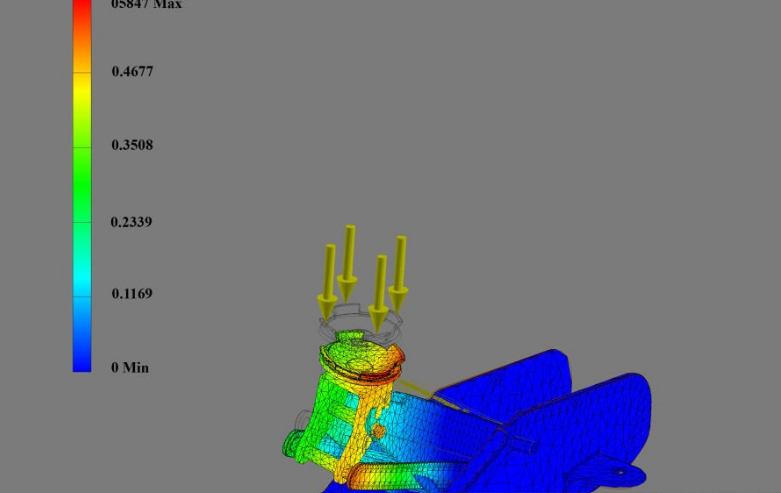
FEA divides a solid part into thousands of small pieces called elements. The software calculates how each element responds to the forces, supports, and temperatures applied to it, then combines the results into a picture of the whole part.
Typical FEA results include:
- Stress, shown as a colour map with the highest values at the likely failure points
- Deflection, showing how far the part bends
- Safety factor against yielding or breaking
- Natural frequencies and vibration shapes
- Fatigue life under repeated loading
- Temperature distribution inside solid parts
For a fuller introduction, see What Is Finite Element Analysis (FEA) and Why Does It Matter?
What Is CFD?
CFD divides the space that a fluid occupies into small cells. The software solves the equations of fluid motion in each cell to predict how the fluid flows through or around the design.
Typical CFD results include:
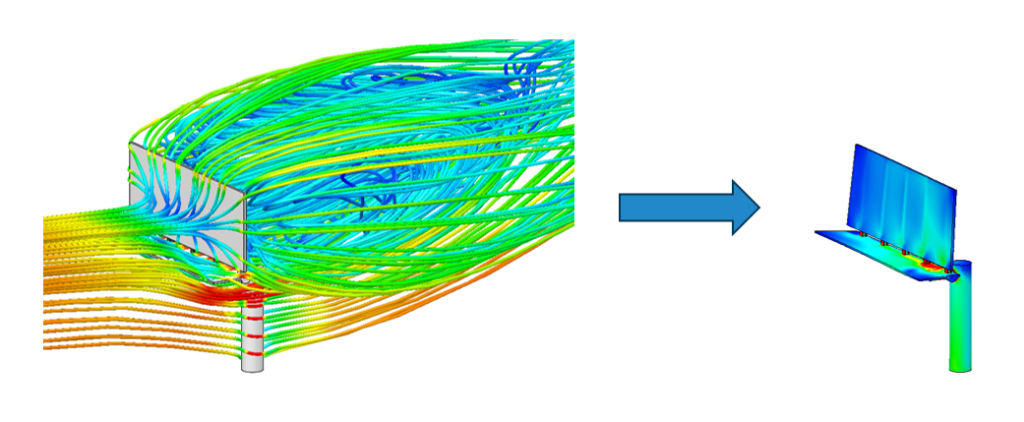
- Velocity and flow direction, often shown as streamlines
- Pressure distribution and pressure drop
- Lift and drag forces
- Areas of turbulence, recirculation, and dead flow
- Temperature of the fluid and of the surfaces it cools or heats
- Mixing and flow rate through each outlet
FEA vs CFD Comparison Table
| FEA | CFD | |
|---|---|---|
| What it studies | Solid parts and structures | Liquids and gases |
| Main question | Will it bend, break, or vibrate? | How does the fluid flow and what does it do? |
| What gets meshed | The solid part itself | The fluid space inside or around the part |
| Typical inputs | Forces, pressures, supports, material properties | Inlet speed or flow rate, outlet pressure, fluid properties |
| Typical outputs | Stress, deflection, safety factor, fatigue life | Velocity, pressure, drag, lift, heat transfer |
| Material data | Stiffness, strength, density | Density, viscosity, thermal properties |
| Usual numerical method | Finite element method | Finite volume method |
| Computing effort | Moderate for most static studies | Usually higher, often with long run times |
| Common software | Ansys Mechanical, Abaqus, SolidWorks Simulation, Nastran | Ansys Fluent, OpenFOAM, STAR-CCM+, SolidWorks Flow Simulation |
FEA shows what happens inside the solid. CFD shows what happens in the fluid around it.
A Technical Note: Method vs Application
Strictly speaking, the two terms are not the same kind of thing. FEA is named after a numerical method, the finite element method. CFD is named after an application area, fluid dynamics.
A CFD problem can be solved with the finite element method, and some software does this. But most CFD codes use a different technique, the finite volume method, because it handles the conservation of mass, momentum, and energy in a flowing fluid more naturally.
In everyday engineering language, FEA has come to mean structural simulation and CFD has come to mean flow simulation. That is how the terms are used in the rest of this article.
You may also see FEM and FEA used interchangeably. FEM is the mathematical method. FEA is the analysis you perform using it.
FEA vs CFD for Thermal Analysis
Heat is where the two overlap, and where the wrong choice is most common. The right tool depends on how the heat moves.
| Heat transfer situation | Better tool | Why |
|---|---|---|
| Heat conducting through solid parts | FEA | Conduction in solids is simple and fast to solve |
| Stress and warping caused by temperature | FEA | Only FEA calculates thermal stress and expansion |
| Cooling by a fan or forced airflow | CFD | The cooling depends on how the air actually flows |
| Natural convection in an enclosure | CFD | The air movement is driven by the heat itself |
| Liquid cooling channels | CFD | Flow distribution and pressure drop matter |
The key limitation of FEA for thermal work is that it does not calculate airflow. To include cooling by air, the engineer has to enter a heat transfer coefficient, which is an estimate of how effectively the surface loses heat. If that estimate is wrong, the temperatures are wrong.
CFD calculates the airflow and the cooling together, so it does not rely on that estimate. The price is a longer setup and solve time.
A practical rule: if the cooling is simple and well understood, thermal simulation with FEA is quick and good enough. If the result depends on where the air goes, use CFD.
When You Need Both
Many products involve a fluid acting on a structure. In those cases the two analyses are run together. This is called fluid-structure interaction, or FSI.
One-way coupling. CFD is run first to find the pressures or temperatures that the fluid applies to the part. Those results are then used as loads in FEA. This is enough when the part does not deform much.
Examples:
- Wind load on a sign, antenna, or solar panel. CFD gives the pressure, FEA checks the structure.
- An electronics enclosure. CFD gives the temperatures, FEA checks thermal stress and distortion.
- A pipe or valve body. CFD gives the internal pressure field, FEA checks the wall.
Two-way coupling. The fluid deforms the part, and the changed shape alters the flow. Both solvers exchange results repeatedly. This is used for flexible blades, flutter, and thin membranes. It is much more demanding and is only worth it when the deformation is large.
Which One Does Your Design Need?
| Your question | Use |
|---|---|
| Will this bracket hold the load? | FEA |
| How much will this frame deflect? | FEA |
| Will this part crack after repeated use? | FEA with fatigue analysis |
| Can I remove material without losing strength? | FEA with design optimization |
| Will this enclosure overheat with the fan I chose? | CFD |
| What is the pressure drop through this manifold? | CFD |
| How much drag does this body produce? | CFD |
| Will this drone arm survive flight loads? | FEA |
| How much thrust does this propeller or duct produce? | CFD |
| Will this heat sink bend the board when it gets hot? | CFD for temperature, then FEA for stress |
Cost, Time, and Accuracy
FEA is usually faster. A linear static study of a single part can be set up and solved in hours. Assemblies with contact, non-linear materials, or impact take longer.
CFD is usually heavier. The fluid volume needs a fine mesh near every surface, turbulence has to be modelled, and the solution is reached through many iterations. Runs of several hours to several days are normal.
Both depend on the inputs. A simulation is only as good as its loads, boundary conditions, material data, and mesh. A colourful result is not proof of a correct one. Good practice for both methods includes checking that the result does not change when the mesh is refined, comparing against a hand calculation, and validating against a physical test where possible.
Common Mistakes
- Using FEA for a cooling problem and guessing the heat transfer coefficient.
- Running CFD when a simple hand calculation would answer the question.
- Trusting a single mesh without checking whether a finer mesh changes the result.
- Reading the peak stress at a sharp corner as real, when it is a numerical artefact.
- Applying loads or constraints that do not match how the part is actually held.
- Treating simulation as a replacement for testing instead of a way to reduce it.
Frequently Asked Questions
Is CFD a type of FEA? No. CFD is the simulation of fluid flow. It can be solved with the finite element method, but most CFD software uses the finite volume method instead.
Is CFD harder than FEA? In general, yes. Fluid flow is non-linear and often turbulent, so setup, meshing, and convergence take more experience and more computing time.
Can FEA simulate fluid flow? Not in the usual sense. Standard FEA packages model solids. They can include the effect of a fluid as a pressure or a heat transfer coefficient, but they do not calculate the flow itself.
Do I need both FEA and CFD? Only if a fluid creates significant loads or temperatures on a structure that also needs checking. Many products need just one.
Which should I learn first? FEA. The concepts of meshing, boundary conditions, and result checking carry over directly to CFD, and structural problems are easier to verify by hand.
Not Sure Which Analysis Your Design Needs?
RunTechEngineer starts every simulation project by defining the question the analysis has to answer, and then chooses the method that fits. Our core work covers structural FEA, thermal simulation, motion studies, and fatigue analysis. Read more about our finite element analysis work.
Contact Us to discuss your design.