RunTechEngineer provides finite element analysis (FEA) services for mechanical parts and assemblies. You send a CAD model and tell us how the part is held and loaded. We return the stress, deflection, and safety factor, show where the design is weakest, and recommend the changes that fix it.
This page covers what we analyze, what we need from you, and what you get back. If you are new to the method, start with what finite element analysis is.
What We Analyze
| Study | Question it answers | Typical parts |
|---|---|---|
| Static stress | Will it yield or deflect too far under a steady load? | Brackets, frames, housings, machine bases |
| Vibration (modal) | Will it resonate at its operating speed? | Machine frames, motor mounts, drone arms |
| Thermal stress | How much does heat distort or stress the part? | Enclosures, heated tooling, parts near motors |
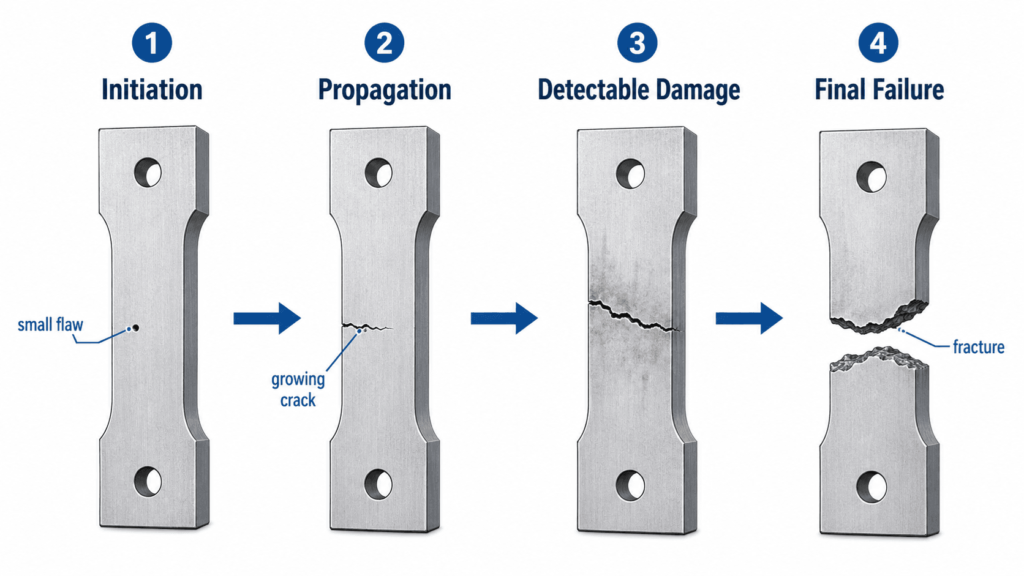
| Fatigue | Will it crack after repeated loading? | Shafts, welded frames, parts that cycle every use |
Most projects start with a static stress study. Heat-driven problems are covered in more detail under thermal simulation, and repeated loading under failure and fatigue analysis.
What We Need From You
- A 3D model. A STEP file is best, because it carries exact solid geometry. If you only have drawings or a physical part, we can build the model through our 3D modeling service.
- The material. Give the grade and condition, for example 6061-T6 aluminium or A36 steel, not just “aluminium” or “steel”.
- How the part is held. Which faces are bolted, welded, clamped, or free to slide.
- The loads. Size, direction, where each one acts, and whether it is steady or repeated.
- What counts as a pass. A maximum deflection, a required safety factor, or a design code the part must meet.
If you are unsure about the loads, tell us how the part is used. Working out a realistic load case is part of the job.
What You Get
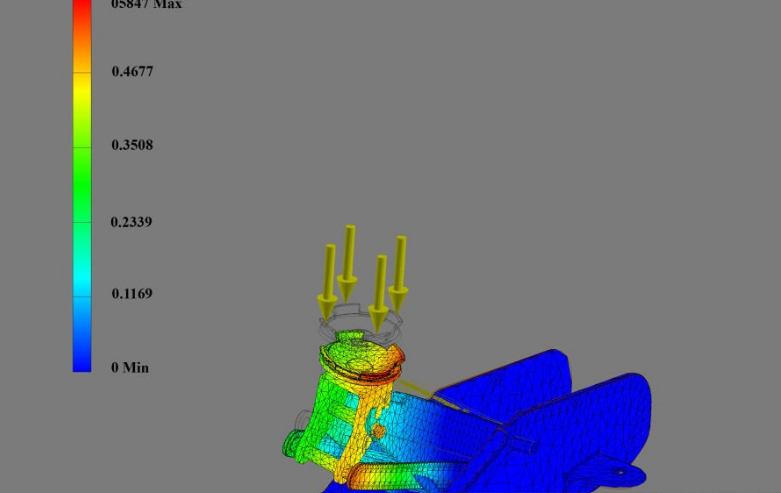
- Stress, displacement, and safety factor plots, each with its scale and units.
- The location and value of the highest stress, and whether it is a real peak or a numerical artefact at a sharp corner.
- A hand calculation on a simplified version of the part, to confirm the simulation is in the right range.
- A mesh refinement check, showing the result does not change when the mesh gets finer.
- A list of every assumption: supports, loads, material data, and anything left out of the model.
- Recommended design changes where the part falls short, or where it carries more material than it needs. See our full guide to von Mises stress.
How We Work
- Define the question. We agree what the analysis has to answer and what result counts as acceptable.
- Prepare the model. We remove features that do not affect strength and keep the ones that do, such as holes and fillets.
- Mesh and solve. The mesh is refined where stress changes quickly.
- Verify. We compare against a hand calculation, check that the reaction forces match the applied loads, and refine the mesh.
- Report. You receive the results with plain-language conclusions and recommendations.
- Re-run after changes. If the design changes, we run it again. Comparing options this way is the basis of design optimization.
When FEA Is Worth It
FEA earns its cost when:
- the geometry has holes, ribs, fillets, or thin walls that no simple formula covers;
- several loads act on the part at once;
- failure would be dangerous or expensive;
- you want to remove weight or material without losing strength;
- a part has already failed and you need to know why.
It adds little for a plain bar, plate, or shaft under a single load. A hand calculation answers that faster, and we will say so if that is your case.
What Affects Cost and Turnaround
- Single part or assembly. Assemblies need contact between parts, which takes longer to set up and solve.
- Number of load cases. Each one is a separate run and a separate set of results.
- Type of study. A linear static study is the quickest. Nonlinear, fatigue, and thermal-stress studies take more time.
- Quality of the CAD model. Clean solid geometry meshes quickly. Imported surfaces with gaps need repair first.
- How well the loads are known. Unknown loads have to be estimated and agreed before any analysis is useful.
Send the model and a short description of the load case, and we will quote before starting.
What FEA Cannot Tell You
A simulation only answers the question it was given. It does not account for material defects, poor welds, corrosion, or a load nobody included. A clean result means the design is adequate for the loads defined, not that the part cannot fail. For parts where failure would be dangerous, simulation narrows the design and a physical test confirms it. We explain these limits, with a worked example, in predicting mechanical failure with FEA.
Frequently Asked Questions
What file format should I send?
STEP is preferred. STL files describe only a surface mesh and usually have to be rebuilt as solid geometry before they can be analyzed properly.
Can you analyze an assembly, not just one part?
Yes. We model how the parts touch, bolt, or weld together. This takes more setup than a single part, so it helps to tell us which joints matter most.
What if I do not know the loads?
Describe how the part is used: what it carries, how it is mounted, and what could go wrong. We work out a load case with you and state it clearly in the report.
Do you guarantee the part will not fail?
No, and nobody honestly can. We report whether the design is adequate for the stated loads, supports, and material, and we list every assumption so you can judge the margin.
Is FEA the right tool for airflow or cooling problems?
Not on its own. Flow problems need CFD, which is a different kind of analysis. See FEA vs CFD to work out which one your design needs.
Need to Know Whether Your Design Will Hold?
Contact us with your CAD model, the material, and how the part is loaded. FEA is one part of our mechanical simulation services.