The Short Answer
Choose stepper motors for small and medium CNC routers, hobby mills, plasma tables, and any machine where cost and simplicity matter more than top speed. Sized correctly, they are accurate and reliable.
Choose servo motors for machines that need high feed rates, fast acceleration, or heavy cutting in metal, and for production work where a missed position must never go unnoticed.
A third option, the closed-loop stepper, sits between the two and is often the best value upgrade for a machine that loses steps.
How a Stepper Motor Works
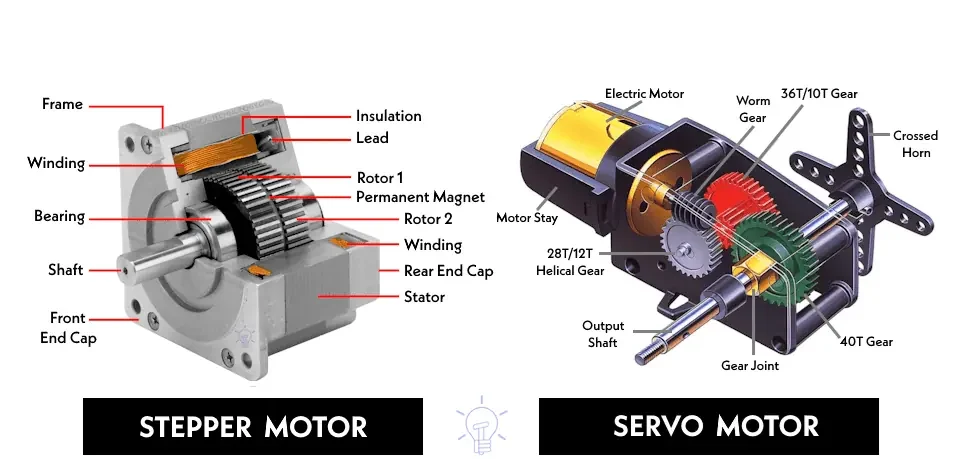
A stepper motor turns in small, fixed increments. A typical CNC stepper has 200 full steps per revolution, which is 1.8 degrees per step. The drive divides these further with microstepping to make motion smoother.
Each pulse from the controller moves the motor one step. The controller counts the pulses it has sent and assumes the motor followed every one. Nothing checks whether it actually did. This is called open-loop control.
Open-loop control is the reason steppers are cheap and easy to set up. It is also their main weakness. If the load is too high or the acceleration too aggressive, the motor skips steps. The controller does not know, the axis is now in the wrong place, and the rest of the job is cut with that error.
How a Servo Motor Works
A servo motor has an encoder on its shaft that reports the real position back to the drive thousands of times per second. The drive compares where the motor is with where it should be and adjusts the current to remove the difference. This is closed-loop control.
Two practical results follow from this:
- The motor uses only as much current as the load requires, so it runs cooler and can deliver a short burst of extra torque when needed.
- If the motor cannot keep up, the drive detects the growing position error and raises a fault that stops the machine, instead of quietly ruining the part.
The Middle Option: Closed-Loop Steppers
A closed-loop stepper, sometimes sold as a hybrid servo or easy servo, is a stepper motor with an encoder added. The drive watches the encoder and corrects small position errors, or raises a fault if it cannot recover.
It still has the torque curve of a stepper, so it does not match a true servo at high speed. But it removes the biggest risk of a normal stepper, the undetected lost step, at a price much closer to a stepper than to a servo.
Stepper vs Servo Comparison Table
| Feature | Stepper | Closed-loop stepper | Servo |
|---|---|---|---|
| Control | Open loop | Closed loop | Closed loop |
| Position feedback | None | Encoder | Encoder |
| Torque at low speed | High | High | Moderate, constant |
| Torque at high speed | Drops sharply | Drops, slightly better | Maintained to rated speed |
| Practical speed range | Low to medium | Low to medium | Up to about 3,000 RPM |
| Lost position | Undetected | Corrected or faulted | Faulted |
| Smoothness and noise | Can resonate, audible | Smoother | Smooth and quiet |
| Heat | Runs warm even at rest | Cooler | Follows the load |
| Setup | Simple | Simple | Requires tuning |
| Cost per axis | Lowest | Medium | Highest |
Torque and Speed
This is the most important technical difference.
A stepper produces its highest torque when it is standing still or turning slowly. As speed rises, the torque falls quickly. Above a few hundred RPM, a typical stepper has only a fraction of its rated torque left. A motor that easily holds the axis at rest can stall during a fast rapid move.
A servo delivers close to its rated torque across its whole speed range, commonly up to about 3,000 RPM, and can briefly produce several times that torque during acceleration.
In practice:
- For slow, strong moves, a stepper is a good match and often needs no gearbox.
- For fast rapids and quick direction changes, a servo keeps its torque where a stepper has run out.
This is also why a stepper’s holding torque figure can mislead. It describes the motor at standstill, not while cutting at speed. Always check the torque-speed curve, not only the headline number.
Accuracy and Lost Steps
It is a common belief that servos are more accurate than steppers. On most small machines this is not true.
A stepper that is not losing steps positions very precisely. On a typical router or bench mill, the real limits on accuracy are mechanical: backlash in the screws, flex in the frame, and wear in the bearings. Fitting servos to a flexible machine does not make it more accurate.
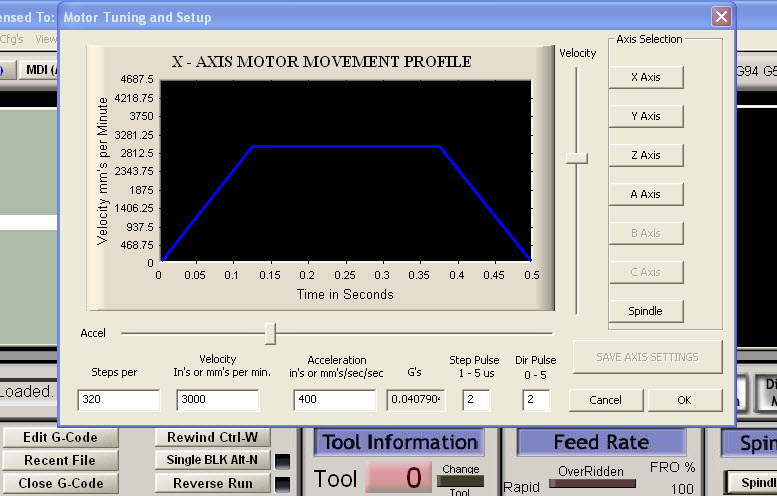
What the servo adds is certainty. It either reaches the commanded position or stops with a fault. A stepper gives no such warning. If your machine sometimes produces parts that are shifted partway through a job, the cause is usually lost steps, and the first things to check are the acceleration and velocity settings covered in motor tuning.
Smoothness, Noise, and Heat
Steppers have a speed band where they resonate. The machine becomes noisy, vibrates, and loses torque in that range. Good drives with anti-resonance features reduce this a lot, but it is a known characteristic.
Steppers also draw close to full current even when they are not moving, so they run warm all the time.
Servos move smoothly and quietly across their range and draw current in proportion to the work they are doing. On a machine that runs many hours per day, this means less heat and lower energy use.
Cost and Complexity
A stepper system has three parts per axis: motor, drive, and power supply. Wiring is simple and there is little to tune.
A servo system costs several times more per axis. It adds encoder cabling and a drive that must be tuned to the machine, although modern drives have auto-tuning that makes this far easier than it used to be. A badly tuned servo can hum, oscillate, or overshoot.
Before spending on servos, check whether the rest of the machine can use them. A light frame, small screws, or a low-speed spindle will limit performance long before the motors do.
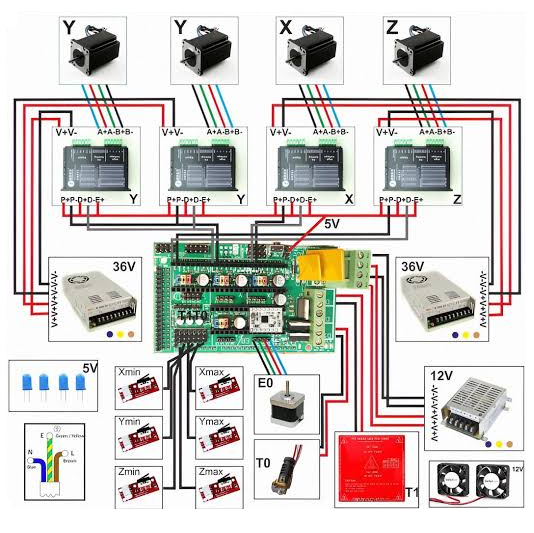
Using Steppers and Servos with Mach3
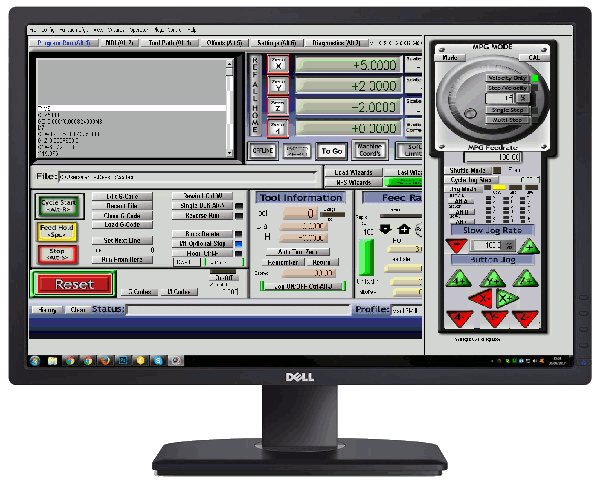
Mach3 controls motors by sending step and direction pulses. It works with both motor types, as long as the drive accepts step and direction signals, which most modern servo drives do.
A few points are specific to Mach3:
- Mach3 does not read the encoder. With a servo or closed-loop stepper, the drive closes the loop on its own. Mach3 still only sends pulses. To make feedback useful, wire the drive’s alarm output to an input in Mach3 so that a fault stops the machine.
- Pulse rate can limit servo speed. Servos have high-resolution encoders, so they need many pulses per revolution. The parallel port in Mach3 has a limited pulse frequency, which can cap the top speed. The usual solutions are electronic gearing in the servo drive or an external motion controller that produces much higher pulse rates.
- Steps per unit must be recalculated. After changing motors or drives, the steps per unit, velocity, and acceleration values all need to be set again during Mach3 setup guide.
Which Motor Should You Choose?
| Your machine | Best choice | Why |
|---|---|---|
| Hobby router or small engraver | Stepper | Low cost, simple, accurate enough |
| Plasma table | Stepper | Low cutting forces |
| Wood router losing steps on rapids | Closed-loop stepper | Removes undetected lost steps at modest cost |
| Bench mill cutting aluminium | Closed-loop stepper or servo | Depends on feed rates and budget |
| Production router with high feed rates | Servo | Torque maintained at speed |
| Metal-cutting mill or lathe | Servo | Position certainty under heavy load |
| Retrofit of an industrial machine | Servo | Matches the mechanics, and original motors can often be kept |
If you are upgrading an older machine, the motor choice is part of a larger decision described in our guide to retrofit support.
Common Mistakes When Choosing CNC Motors
- Choosing a stepper by holding torque alone and ignoring the torque-speed curve.
- Fitting a much larger stepper to fix lost steps. Larger steppers lose torque at speed even faster.
- Running steppers on a low-voltage power supply, which limits their speed.
- Buying servos for a machine whose frame and screws cannot use the extra performance.
- Installing servos or closed-loop steppers without connecting the alarm signal to the controller.
- Setting acceleration at the limit of what the motor can do, with no safety margin.
Frequently Asked Questions
Are servo motors more accurate than stepper motors? Not automatically. A stepper that does not lose steps is very accurate. The servo’s advantage is that it detects and reports position errors instead of continuing with them.
Can I use servo motors with Mach3? Yes, with servo drives that accept step and direction signals. The drive handles the feedback, and its alarm output should be wired to Mach3.
Why does my stepper motor lose steps? The usual causes are acceleration or velocity set too high, a power supply voltage that is too low, mechanical binding, resonance, or electrical noise on the signal wires.
Is a closed-loop stepper the same as a servo? No. It adds feedback to a stepper, so it can correct or report errors, but it keeps the stepper’s falling torque at high speed.
Is it worth upgrading from steppers to servos? Only if speed or lost steps are actually limiting your work and the machine is rigid enough to benefit. Otherwise, better tuning or closed-loop steppers usually give more improvement for the money.
Need Help Choosing or Setting Up CNC Motors?
RunTechEngineer selects, wires, and tunes motor and drive systems for our Mach3 CNC controller services, so the axes are fast where they can be and reliable everywhere. If your machine is already built and misbehaving, start with troubleshooting and calibration.
Contact Us to discuss your machine.