
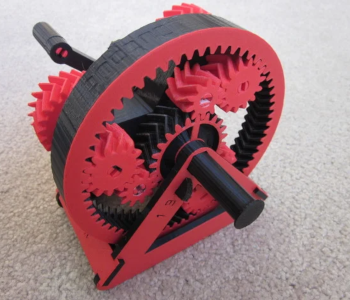
Functional 3D printed parts are made to be used, not just looked at. They carry load, fit into an assembly, and survive handling day after day. RunTechEngineer prints functional parts such as brackets, jigs, housings, and end-use components, with the material, print orientation, and wall thickness chosen for the job the part has to do.
This page explains what makes a print functional, how we build strength into it, and what we need from you to get started.
Prototype or Functional Part?
The same printer makes both, but the priorities are different.
| Prototype | Functional part | |
|---|---|---|
| Purpose | Check shape, fit, and appearance | Do a real job in use |
| What matters most | Speed and low cost | Strength, durability, and fit |
| Print settings | Thin walls, light infill | Thicker walls, more infill, load-aware orientation |
| Material | Whatever prints fastest | Chosen for load, heat, and environment |
| Lifetime | Days or weeks | Months or years |
If you only need to check form and fit, rapid prototyping is quicker and cheaper. If the part has to work, read on.
How We Build Strength Into a Print
A printed part is not uniformly strong. How it is printed matters as much as what it is printed from.
- Orientation. A print is weakest between its layers. In one manufacturer’s PLA datasheet, specimens pulled across the layers broke at 33 MPa, against 52 to 59 MPa along them. We orient each part so the main load runs along the layers. See how strong PLA is for the full figures.
- Wall thickness. In bending, most of the load is carried by the outer skin, so extra walls usually add more strength than extra infill.
- Infill. We raise infill for small, highly loaded parts and keep it moderate where it would only add weight and print time.
- Material. Load, temperature, sunlight, moisture, and chemicals all narrow the choice.
- Design details. Rounded internal corners, thicker sections at stress points, and holes sized for the fasteners or inserts you plan to use.
If the design was made for machining or molding, a design-for-3D-printing review will catch features that print badly before any plastic is used.
Choosing the Material
| The part needs to | Typical starting point |
|---|---|
| Hold a light, steady load indoors | PLA |
| Take knocks or flex slightly without cracking | PETG |
| Work near heat or in a vehicle | ABS or ASA |
| Live outdoors in sun and rain | ASA or PETG |
| Bend, grip, or seal | TPU |
| Resist wear on sliding or moving surfaces | Nylon |
These are starting points, not rules. The material selection guide walks through the choice by requirement, and PLA vs ABS vs PETG compares the three most common filaments side by side.
What We Need From You
- A 3D model. A STEP file is best, because we can adjust it for printing. An STL works if no changes are needed. No model yet? We can create one through our 3D modeling service.
- How the part is loaded. What it holds, where the force acts, and whether the load is steady, repeated, or sudden.
- Where it will be used. Indoors or outdoors, near heat, in contact with oil, water, or chemicals.
- Which dimensions matter. Mating faces, hole positions, and anything that has to fit another part.
- How many you need. One part and fifty parts are planned differently. For larger quantities see small-batch 3D printing.
Where Functional 3D Printing Makes Sense
- Jigs, fixtures, and drill guides made for one job on one machine.
- Custom brackets and mounts for sensors, cables, guards, and covers.
- Enclosures and housings for electronics and controls.
- Replacement parts that are no longer sold or would take weeks to order.
- End-use components in low volumes, where injection mold tooling would never pay for itself.
When Another Process Is the Better Choice
Printing is not always the right answer, and we will say so when it is not.
- High loads or tight tolerances. Metal parts and precise fits are better made by CNC machining.
- High temperatures. Common printing plastics soften well below the temperatures metals handle easily.
- Large quantities. Past a certain volume, molding or machining costs less per part.
- Safety-critical parts. Printed strength varies with orientation and print quality. A part whose failure could injure someone needs testing, and often a different process.
Frequently Asked Questions
Are 3D printed parts strong enough for real use?
Yes, for many jobs. Brackets, jigs, housings, and light mechanical parts work well when the material and print orientation suit the load. They are not a direct replacement for metal: a printed plastic part has to be thicker to carry the same load, and it is far less stiff.
What is the strongest way to print a part?
With the main load running along the layers, not across them, and with enough wall thickness to carry it. The strongest orientation is not always the easiest to print, so it is decided part by part.
Which material is best for functional parts?
There is no single best one. PETG is a common all-round choice, ABS and ASA handle more heat, and nylon resists wear. The right answer depends on the load and the environment.
Can you print a part from a drawing or a broken sample?
Yes. We model the part first and then print it. Tell us which dimensions have to match the original.
How accurate are printed parts?
Accurate enough for most brackets, covers, and fixtures, but less precise than machining. If a dimension is critical, tell us, and we will plan the print around it or recommend machining that feature.
Need a Part That Has to Work, Not Just Look Right?
Contact us with your model, how the part is loaded, and where it will be used. Functional part printing is one of our 3D printing services.
Pingback: 3D Printing Material Selection Guide for Functional Parts