What Is Von Mises Stress?
Von Mises stress is a single number that combines all the stresses acting at a point into one equivalent value. If it reaches the material’s yield strength, a ductile metal is predicted to start yielding at that point.
It comes from the von Mises yield criterion, also called the maximum distortion energy criterion. The idea is that a ductile metal yields when the energy stored in changing its shape, not its volume, reaches a critical level. Von Mises stress is the stress in a simple tensile test that would store the same distortion energy.
That is why it is the default stress plot in most FEA software, and why engineers compare it directly with yield strength.
Why One Number Is Needed
At any point inside a loaded part, stress is not one value. It has three normal stresses and three shear stresses, which together form the stress tensor. A tensile test, on the other hand, gives one number: the yield strength.
Von Mises stress bridges that gap. It turns the full stress state into one value that can be compared with the one number from the material data sheet.
The Von Mises Stress Formula
The formula has three common forms. They give the same answer; use whichever matches the stresses you have.
From the three principal stresses:
σv = √( ½ [ (σ1 − σ2)² + (σ2 − σ3)² + (σ3 − σ1)² ] )
For plane stress (σ3 = 0), from principal stresses:
σv = √( σ1² − σ1σ2 + σ2² )
For one normal stress plus one shear stress, the common case in shafts, beams, and bolts:
σv = √( σ² + 3τ² )
Two useful results follow. In simple tension, σv equals the applied stress, so the criterion matches the tensile test. In pure shear, σv = √3 × τ, so a ductile metal yields in shear at about 0.577 times its tensile yield strength.
Worked Example: A Shaft in Bending and Torsion
A steel shaft carries a bending stress of 120 MPa and a torsional shear stress of 50 MPa at its surface. The material is S355 structural steel, with a yield strength of 355 MPa.
| Step | Calculation | Result |
|---|---|---|
| Von Mises stress | √(120² + 3 × 50²) = √(14,400 + 7,500) | 148 MPa |
| Safety factor against yield | 355 ÷ 148 | 2.4 |
The bending stress alone is 120 MPa, but the shear adds to it. Checking bending stress against yield would have overstated the margin.
A second example uses principal stresses from a plate in plane stress: σ1 = 200 MPa and σ2 = 50 MPa.
σv = √(200² − 200 × 50 + 50²) = √32,500 = 180 MPa
Here the result is lower than the largest principal stress, because the second stress pulls in the same direction and reduces distortion. When the two principal stresses have opposite signs, von Mises stress comes out higher than either.
Von Mises vs Tresca
Tresca, or the maximum shear stress criterion, is the other common yield criterion for ductile metals.
| Von Mises | Tresca | |
|---|---|---|
| Based on | Distortion energy | Maximum shear stress |
| Shaft example above | 148 MPa, safety factor 2.4 | √(120² + 4 × 50²) = 156 MPa, safety factor 2.3 |
| Shear yield strength | About 0.577 × yield | 0.5 × yield |
| Typical use | Default in FEA and most machine design | Some design codes, and when a more conservative check is wanted |
Tresca is never less conservative than von Mises. For most parts the two differ by only a few percent; the gap is largest in pure shear.
How to Read a Von Mises Plot in FEA
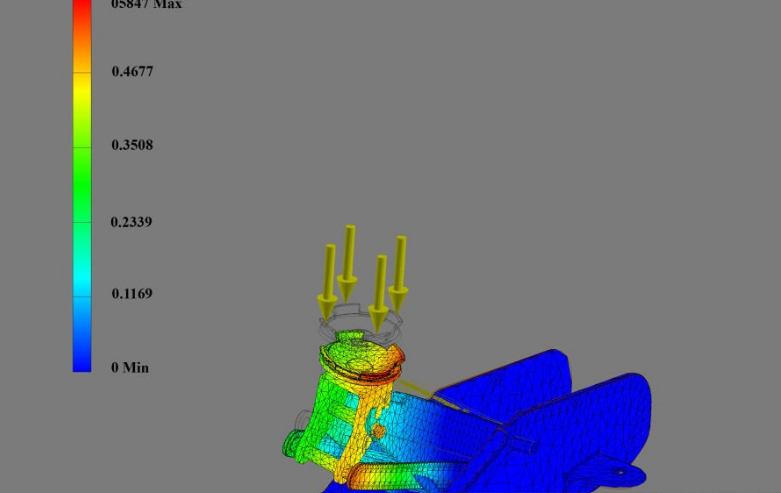
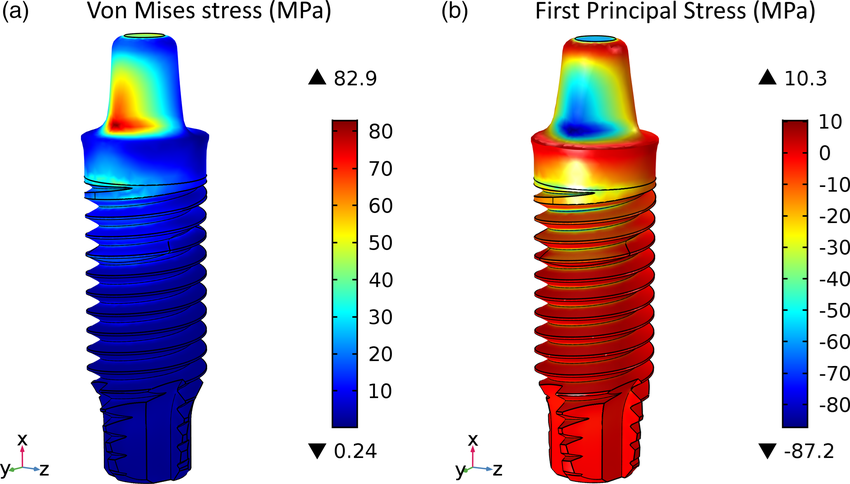
A von Mises contour plot is the quickest way to see where a part is working hardest. It is also easy to misread.
- It is always positive. Von Mises stress does not tell you whether a point is in tension or compression. Check the principal stress plots when the sign matters.
- Red is not automatically a problem. Compare the peak value with the yield strength and your required safety factor, not with the colour scale.
- Beware of singularities. Sharp internal corners, point loads, and point supports produce stresses that keep rising as the mesh gets finer. They are a modelling artefact, not a real result. Add a realistic fillet or spread the load.
- Check the mesh at the peak. Refine the mesh where the stress is highest and rerun. If the peak changes a lot, the first result was not converged.
- Know which value is shown. Many programs average stresses between elements by default. Unaveraged results show the true spread and help judge mesh quality.
Our worked example of predicting failure with FEA shows these checks on a real model, including a hand calculation to confirm the result.
When Von Mises Stress Is the Wrong Check
Von Mises stress predicts the start of yielding in ductile, isotropic materials. Outside that case, use a different check.
| Situation | Why von Mises falls short | Use instead |
|---|---|---|
| Brittle materials such as cast iron, glass, or ceramics | They fracture before they yield, and are much weaker in tension than in compression | Maximum principal stress, or Mohr-Coulomb |
| Repeated loading | Fatigue depends on stress range, mean stress, and sign | A fatigue analysis |
| Slender parts in compression | They can buckle at stresses far below yield | A buckling analysis |
| Composites and 3D-printed parts | Strength depends on direction, such as fibre or layer orientation | Direction-dependent failure criteria |
| Parts loaded beyond yield | Stress no longer rises in proportion to load | A nonlinear analysis with a plastic material model |
Frequently Asked Questions
Is von Mises stress the same as maximum stress?
No. It is an equivalent stress that combines all the stress components at a point. It can be higher or lower than the largest single stress component.
Can von Mises stress be negative?
No. It is calculated as a square root, so it is always zero or positive. It does not show whether a point is in tension or compression.
How do you calculate a safety factor from von Mises stress?
Divide the yield strength by the peak von Mises stress. A steel part with 250 MPa yield and a peak von Mises stress of 125 MPa has a safety factor of 2 against yielding.
What is the difference between von Mises stress and principal stress?
Principal stresses are the three normal stresses acting on planes with no shear. Von Mises stress combines them into one value for checking yield in ductile materials. Principal stresses are the better check for brittle materials.
Can von Mises stress be used for plastics?
For tough, ductile plastics it gives a reasonable first check. For brittle plastics, and for 3D-printed parts whose strength depends on layer direction, it can overstate the margin.
Not Sure Your Part Will Hold?
RunTechEngineer runs stress analysis on parts and assemblies, checks the results against hand calculations, and reports where the part is closest to failing and what to change. See our finite element analysis services, or contact us with your part, its material, and the loads it carries.